What makes glycolysis stop?
Follow the energy. Track the electron carriers. Discover why a cell needs to recycle NAD⁺.
◎ Start here: where does glycolysis happen?Explore the reference ↓
In the cytosol, across almost all cells.
Glycolysis occurs in the cytosol—the fluid portion of the cytoplasm. It needs no specialized organelle and is a conserved pathway found in almost all cells, including prokaryotic and eukaryotic cells.
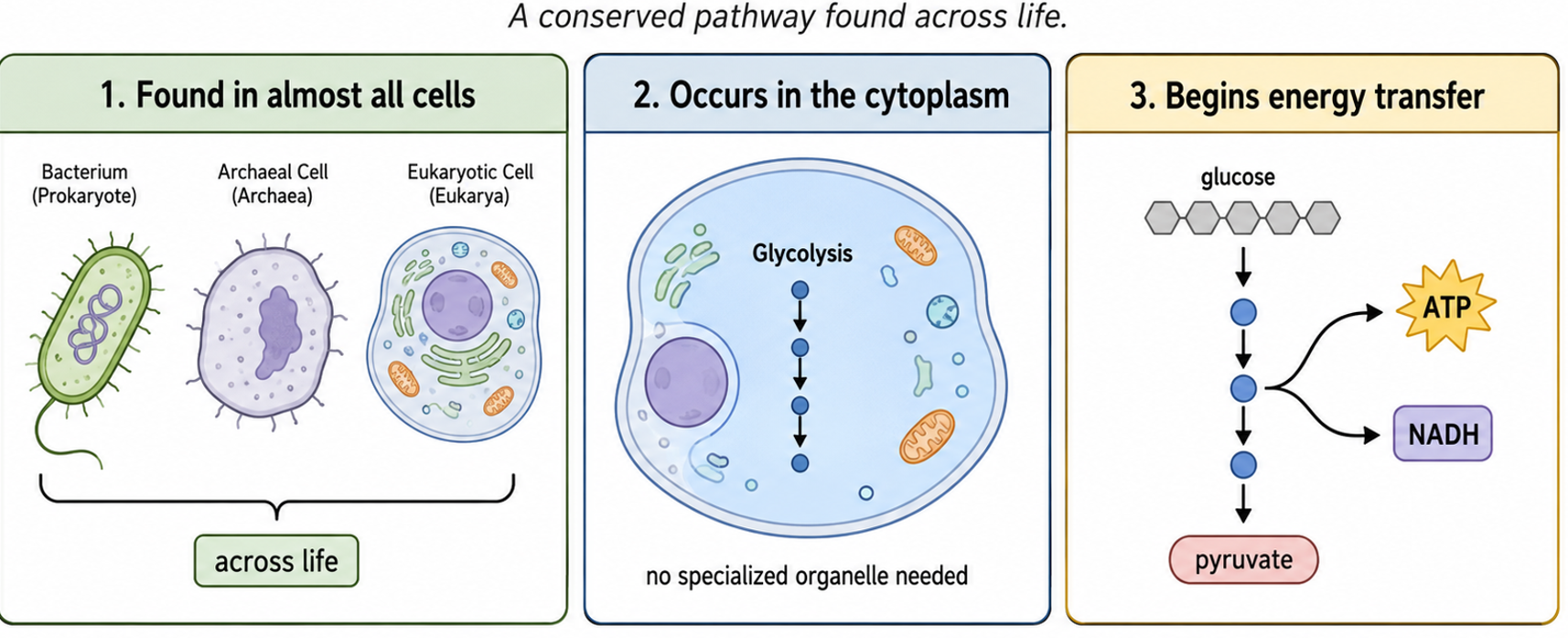
Read the reference as a conceptual overview. Symbols are not molecular structures; one glucose yields two pyruvate molecules.
A finite supply. A stalled pathway.
Run glycolysis until it stops. Is glucose the limiting resource?
Carbon accounting
Experiment record
| Action | Glucose | NAD⁺ | NADH | Net ATP |
|---|
Teacher notes · model boundaries & CED alignment
Aligned to the supplied 2025 AP Biology CED: 3.5.B.1 (glycolysis produces ATP, NADH and pyruvate), 3.5.B.6 (fermentation allows glycolysis to proceed without oxygen), and the conserved-pathway concept in 3.1. See framework pp. 77–78 for Topic 3.5.
Each glycolysis action summarizes a whole pathway: 1 glucose → 2 pyruvate; 2 NAD⁺ → 2 NADH; net 2 ATP. ATP formation from ADP and inorganic phosphate is summarized as a net gain. ATP investment, enzymes, intermediates and molecular structures are not modeled or assessed. The CED excludes memorization of pathway steps, enzymes and structures.
This closed, finite model isolates NAD⁺ availability; ADP, inorganic phosphate and other requirements are assumed sufficient. It does not model reaction rates or partially completed pathways. Glycolysis does not directly require oxygen. In cells with aerobic respiration, other processes can regenerate NAD⁺. Here that route is excluded.
The fermentation tab compares lactate (lactic acid) fermentation and alcoholic fermentation. Lactate retains all three carbons of pyruvate; alcoholic fermentation releases one carbon as CO₂ per pyruvate and yields two-carbon ethanol. The alcoholic route shows a temporary 2C organic acceptor after CO₂ release so that electron transfer occurs before ethanol appears. Its name, enzymes and molecular structures are not assessed. Moving electron symbols summarize reduction, not a free-electron mechanism or an elementary reaction. Fermentation and glycolysis can occur alongside each other in cells. Carbon circles represent carbon counts, not molecular structures; electron symbols represent transfer, not electron stoichiometry. The animation summarizes the pathway and does not imply that splitting glucose alone transfers electrons. Organism examples and carbon bookkeeping support conceptual understanding; they are not an added memorization requirement.